
Consistency and discipline often outperform timing and luck in investing. That’s where a Systematic Investment Plan (SIP) comes in. Whether you’re an experienced investor or just starting out, SIPs can be a powerful tool for long-term wealth creation.
What is SIP?
SIP is a simple way to invest in mutual funds by contributing a fixed amount at regular intervals. Think of it like a fitness routine: just as regular workouts build strength, SIPs steadily grow your wealth over time.


Once you set up a SIP, the chosen amount is automatically debited from your bank account and invested in your selected mutual fund scheme at the scheduled interval, without any manual intervention required.
Each contribution buys units of the mutual fund scheme at the prevailing market price. Over time, these units accumulate at your chosen frequency.
SIP may be an effective tool of investing during volatile market. When the fund’s Net Asset Value (NAV) is low, you buy more units for the same amount.
Let’s see this with an example
Let’s say you decide to invest ₹5,000 every month in an equity mutual fund through SIP. The following illustration shows how market movements impact unit accumulation and average cost per unit.
| Month 1 | Month 2 | Month 3 | |
|---|---|---|---|
| NAV | ₹50 | ₹40 | ₹60 |
| Units Allotted | ₹5,000 ÷ ₹50 = 100 Units | ₹5,000 ÷ ₹40 = 125 Units | ₹5,000 ÷ ₹60 = 83.33 Units |
| Total Investment (₹) | Total Units Accumulated | Average Cost per Unit (₹) |
|---|---|---|
| ₹15,000 | 308.33 | ₹48.65 (₹15,000 ÷ 308.33) |
As you can see, even though the NAV fluctuated, your average cost per unit (₹48.65) is lower than the current NAV (₹60).
Fundamentals of SIP
SIPs work on two powerful principles
Compounding
Compounding is the process where your initial investment generates returns, and those returns are reinvested to generate returns. Over time, this creates a cycle where both your original investment and accumulated returns keep growing, making your wealth increase the longer you stay invested. However, maintaining regular contributions is important to achieve your financial goals and maximize the benefits of compounding.
Example:
Let’s compare two investors:
• Riya starts investing ₹2,000 per month at age 25 and continues till age 45 (20
years).
Assuming a 12% annual return, her corpus at 45 will be approximately ₹19.9 lakhs.
• Amit starts investing the same ₹2,000 per month at age 35 and continues till age
45 (10 years).
His corpus at 45 will be around ₹4.6 lakhs.
Despite investing the same monthly amount, Riya ends up with over 4 times more than
Amit, just because she started earlier and gave compounding more time to work.
The earlier and consistently you invest, the greater your potential to build wealth.
SIPs make this easy by encouraging disciplined, long-term investing.
Rupee Cost Averaging
SIPs help you navigate market volatility by removing the need to time the market. By investing a fixed amount regularly, you automatically buy more units when prices are low and fewer when prices are high. Over time, this averages out your purchase cost and may reduce the impact of market fluctuations.
Example:
Imagine you invest ₹5,000 every month. In a rising market, you’ll buy fewer units, and in a falling market, you’ll buy more. This strategy helps you accumulate investments at a lower average cost over time, without having to predict market movements.
Benefits of SIP

Rupee Cost Averaging
Invest regularly, buy more when prices are low, fewer when high thereby reducing average cost.

Power Of Compounding
Reinvested returns may help grow your money.

Convenience & Automation
Runs on auto-pilot no missed investments.

Flexibility & Convenience
Start, stop, or modify anytime to suit your financial needs.

Goal- Based Investing
Align SIPs with goals like home purchase ,education, or retirement.

Suitable for All Investors
Options for both conservative and aggressive investors.

Behavioural Discipline
Prevents impulsive decisions during market swings.

Low Entry Barrier
No need for a large corpus. SIP allows you to begin your investment journey with small, regular contributions—can be perfect for beginners.
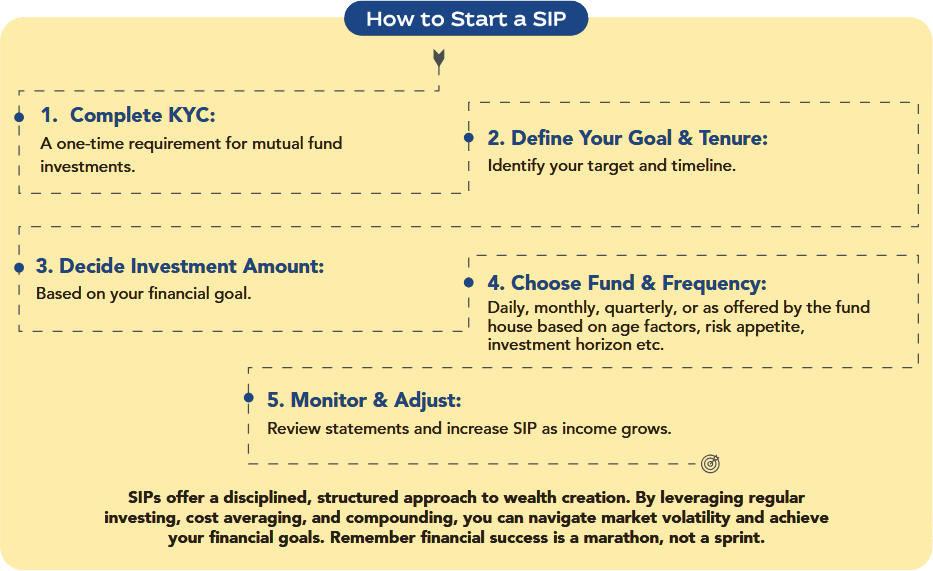
FAQ
A Systematic Investment Plan (SIP) automatically invests a fixed amount into a mutual fund scheme at regular intervals. This disciplined approach helps you avoid timing the market. When prices are low, you buy more units; when prices are high, you buy fewer units. Over time, this averages out your cost and reduces the impact of market volatility, making SIPs a smart way to invest consistently.
The minimum investment amount varies by mutual fund scheme. Many schemes allow you to start with a small contribution, often beginning from ₹100, ₹250, or ₹500, depending on the specific plan. This flexibility makes SIPs accessible for all types of investors.
Lump sum investments, involve investing a large amount in mutual fund schemes in one go, on the other hand, SIP spreads your investment over time, reducing the risk of investing all your money at once during market highs. This approach mainly minimizes risk of timing the market and may help manage volatility.
There are no charges or late fees levied if you miss an SIP instalment. That particular instalment is skipped, and it will typically resume from the next scheduled date without any issues. However, maintaining regular contributions is important to achieve your financial goals and maximize the benefits of compounding. Please note that if multiple instalments (usually three or more) are missed, your bank or the fund house may cancel the SIP mandate.
Yes! You can top up your SIP anytime to accelerate wealth creation. Many fund houses offer top up feature, which allows you to automatically increase your SIP amount annually by a fixed percentage or amount. This helps you gradually invest more as your income grows, without manual intervention.
Yes! SIPs are flexible. You can cancel or change your SIP amount, change investment date, or even switch funds from one scheme to the other scheme without any charges. It’s designed to give you complete control over your investments.
Start Your SIP Today, Stay Consistent!
Disclaimer : Mutual Fund investors
need to complete the Know Your Customer (KYC) process,
which can be done by submitting completed KYC Form along with the required documents at any
AMC's branch Office or Official Points of Acceptance. Please refer
https://www.licmf.com/kyc-redressal to know about KYC documentary
requirement, procedure for
change of address, phone number, bank details etc. The investors are cautioned to invest
only with SEBI registered Mutual Funds, the details of which can be verified on SEBI's
website under 'Intermediaries/Market Infrastructure Institutions'
https://www.sebi.gov.in/intermediaries.html. For any complaints and grievance
redressal,
investors can contact the Investor Relations Officer of the respective AMC and if not
satisfied with the resolution given by the AMC, he/she can approach SEBI by registering the
complaint on SEBI SCORES Portal https://scores.sebi.gov.in/ and/or
escalate the compliant
through Online Dispute Resolution Portal https://smartodr.in/login.
